patrick.net
An Antidote to Corporate Media
1,354,232 comments by 15,730 users - clambo, mell online now
EPA Approves Rise in Glyphosate Residue for Monsantos Herbicide - TOO LATE!
2013 Jun 22, 4:17pm 6,617 views 69 comments
by puhim follow (0)
« First « Previous Comments 30 - 69 of 69 Search these comments
Talking about wasting taxpayer money, if you're really concerned about that then you should demand the FDA stop wasting FED salaries on busting raw dairy farmers and requiring labeling on raw milk, as it is safe > 99.99% of the time. At the minimum, let's use the numbered labeling system we discussed and let us have equally free access to raw milk than we have to GMOs :)
Where's the science based backing for defending the usfedgov in this wasteful attack against the health of the populace
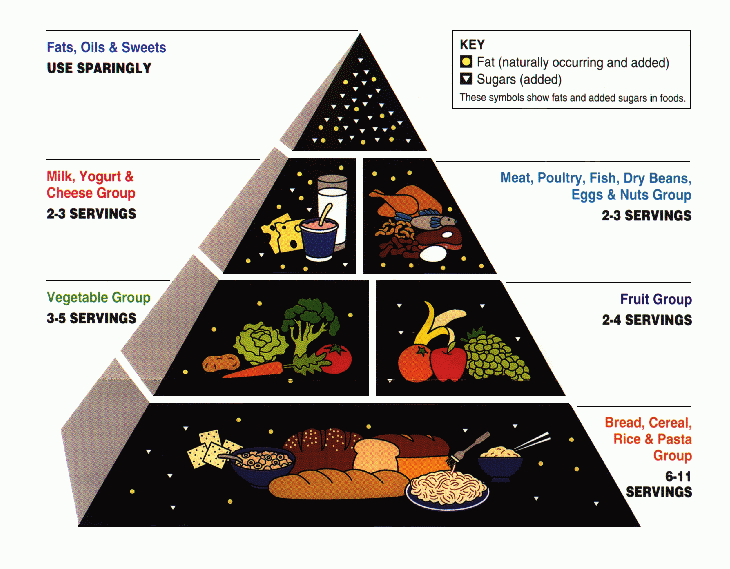
The same government that insisted for decades, that a healthy diet consists of over two dozen daily servings of "food groups", with half of that being cereals, bread and grains, rice and pasta, is now supposed to be THE source for what is and what isn't healthy? That's your "science" LOL
------------
http://www.rurdev.usda.gov/rbs/pub/sep08/feeling.htm
100M+$ mistake by the worthless FDA
--------------
 New Renter
2013 Jun 27, 3:32am
New Renter
2013 Jun 27, 3:32am
Talking about wasting taxpayer money, if you're really concerned about that then you should demand the FDA stop wasting FED salaries on busting raw dairy farmers and requiring labeling on raw milk, as it is safe > 99.99% of the time. At the minimum, let's use the numbered labeling system we discussed and let us have equally free access to raw milk then we have to GMOs :)
http://www.cdc.gov/foodsafety/rawmilk/raw-milk-index.htm
You go ahead, I'll stick with pasteurized.
 Homeboy
2013 Jun 30, 1:23pm
Homeboy
2013 Jun 30, 1:23pm
Where's the science based backing for defending the usfedgov in this wasteful attack against the health of the populace
They don't use the food pyramid anymore. Try to keep up.
Since a lot of evidence has come to light that processed grains are not healthy, the USDA now recommends consuming whole grains, and no longer recommends larger amounts than the other food groups. Isn't that pretty much the very definition of science? When the evidence contradicts your hypothesis, you change the hypothesis. The problem with the "alternative" crowd is that they don't use science AT ALL. They just accept the word of a few nutballs as dogma.
Homeboy
2013 Jun 30, 1:25pm
The FDA and GMOs.
Outright lie. All GMO foods have been tested. You guys have absolutely no standards as to the sources of your "information".
Homeboy
2013 Jun 30, 1:29pm
Talking about wasting taxpayer money, if you're really concerned about that then you should demand the FDA stop wasting FED salaries on busting raw dairy farmers and requiring labeling on raw milk, as it is safe > 99.99% of the time. At the minimum, let's use the numbered labeling system we discussed and let us have equally free access to raw milk then we have to GMOs :)
Wait. So you think the government should NOT regulate raw milk, which has caused demonstrable cases of illness, but they SHOULD regulate GMOs, which have never caused even a single illness, ever.
Yeah, that makes sense...
Talking about wasting taxpayer money, if you're really concerned about that then you should demand the FDA stop wasting FED salaries on busting raw dairy farmers and requiring labeling on raw milk, as it is safe > 99.99% of the time. At the minimum, let's use the numbered labeling system we discussed and let us have equally free access to raw milk then we have to GMOs :)
Wait. So you think the government should NOT regulate raw milk, which has caused demonstrable cases of illness, but they SHOULD regulate GMOs, which have never caused even a single illness, ever.
Yeah, that makes sense...
They should label both, so people can have a choice. I don't object to the warning on raw milk that says that raw dairy can cause food-borne illness since it is a possibility, albeit very small. The health benefits of raw milk though outweighs that risk for many who make that conscious choice. Keep in mind that many countries (incl. the US in earlier years) have been allowing the sale of raw dairy without ever having significant occurrences of food-borne illness, not moving the needle to anywhere close to statistically significant, like the pro-GMO studies claim to. I have my preferences but I'd be ok with labeling for both (the vast majority of food-borne illness comes from vegetables btw.).
Homeboy
2013 Jun 30, 2:01pm
They should label both,
Then why did you say it was a "waste of fed salaries" to label raw milk? You seem to be contradicting yourself.
Homeboy
2013 Jun 30, 2:05pm
(the vast majority of food-borne illness comes from vegetables btw.).
Right, and that has nothing to do with GMO. So why are you demanding that we put labels to warn of something that has caused ZERO illnesses, when there are other things that cause illness all the time, and don't require any special labeling?
They should label both,
Then why did you say it was a "waste of fed salaries" to label raw milk? You seem to be contradicting yourself.
That wasn't regarding the labeling, that has been on forever. They have been clamping down in recent years and made it much harder to distribute raw dairy apart from the labeling and busted raw milk farmers on the basis of new regulations with grey areas. Litigation is going on still today, but it is very hard to figure out what rules apply for interstate vs intrastate sale and sale to the public vs sale to farms vs sale within co-ops. I'd' call that taxpayer money waste, let alone that not a single case of the busts confirmed any contamination.
Right, and that has nothing to do with GMO. So why are you demanding that we put labels to warn of something that has caused ZERO illnesses, when there are other things that cause illness all the time, and don't require any special labeling?
It hasn't caused ZERO illnesses, all you can talk about are risk probabilities at this point. Labeling is necessary, warning label or not I don't care. To the argument that there is a non-GMO choice with Organic or explicit non-GMO labels I'd say there is also a label for non-raw-dairy which reads "pasteurized".
(the vast majority of food-borne illness comes from vegetables btw.).
when there are other things that cause illness all the time, and don't require any special labeling?
I agree with this in the sense that warning label on raw vegetable and fruits could be considered as they cause the majority of food-borne illnesses, and it doesn't even have to be contaminated at first, but due to the packaging process contamination from workers can thrive in that packaging. Whether it will be cost-effective overall is another question, but it's an easy and quick way to educate people who don't wash the contents thoroughly.
New Renter
2013 Jun 30, 2:58pm
(the vast majority of food-borne illness comes from vegetables btw.).
when there are other things that cause illness all the time, and don't require any special labeling?
I agree with this in the sense that warning label on raw vegetable and fruits could be considered as they cause the majority of food-borne illnesses, and it doesn't even have to be contaminated at first, but due to the packaging process contamination from workers can thrive in that packaging. Whether it will be cost-effective overall is another question, but it's an easy and quick way to educate people who don't wash the contents thoroughly.
Just assume the people who pick and handle your food do not have access to a handwash station after they use the porta potty. There's no toilet paper in there either.
Homeboy
2013 Jun 30, 3:41pm
That wasn't regarding the labeling,
I quote:
you should DEMAND THE FDA STOP WASTING FED SALARIES on busting raw dairy farmers AND REQUIRING LABELING ON RAW MILK...
(emphasis mine)
You wrote that, not me. How can you say it "wasn't about the labeling" when you clearly wrote that it was?
It hasn't caused ZERO illnesses,
Excuse me, but you can't just SAY "it hasn't caused zero illnesses", because that is false. There has never been a case of any person becoming ill due to the genetic modification of food that they ate, that was approved for sale. If you think otherwise, please give us the name of the person who became ill, and your proof that the genetic modification of the food was the reason for the illness.
all you can talk about are risk probabilities at this point.
Wrong. I can make the statement that nobody has ever had an illness due to GMO food that they consumed, because it is true. Again, if you think otherwise, prove it.
To the argument that there is a non-GMO choice with Organic or explicit non-GMO labels I'd say there is also a label for non-raw-dairy which reads "pasteurized"
I am not arguing for labeling of raw milk. I am simply stating that your position vis a vis raw milk is inconsistent with your position vis a vis GMO food.
Homeboy
2013 Jun 30, 3:46pm
(the vast majority of food-borne illness comes from vegetables btw.).
when there are other things that cause illness all the time, and don't require any special labeling?
I agree with this in the sense that warning label on raw vegetable and fruits could be considered as they cause the majority of food-borne illnesses, and it doesn't even have to be contaminated at first, but due to the packaging process contamination from workers can thrive in that packaging. Whether it will be cost-effective overall is another question, but it's an easy and quick way to educate people who don't wash the contents thoroughly.
Why did you cut off half of my sentence? Is it because you wanted to avoid answering my question and try to change the issue?
Here it is again for you:
Right, and that has nothing to do with GMO. So why are you demanding that we put labels to warn of something that has caused ZERO illnesses, when there are other things that cause illness all the time, and don't require any special labeling?
Just answer the question. Stop pretending that I'm arguing for labeling, when YOU are the one demanding labeling, and I am simply pointing out the inconsistency in your position.
(emphasis mine)
You wrote that, not me. How can you say it "wasn't about the labeling" when you clearly wrote that it was?
Half point taken ;) It's a bit more complex than that as the FDA works with state legislature to enforce stricter labeling (additional labeling such as "unfit for human consumption") or even bans while it does not acknowledge states that relax said labeling and distribution. I'd be either for uniform (warning) labeling or letting the states handle it entirely on their own. Here's a decent article about the developments in regulations and stats for food-borne illness of raw vs pasteurized millk and more:
http://www.huffingtonpost.com/2011/08/05/raw-milk-regulations-tighen_n_919177.html
Excuse me, but you can't just SAY "it hasn't caused zero illnesses", because that is false. There has never been a case of any person becoming ill due to the genetic modification of food that they ate, that was approved for sale. If you think otherwise, please give us the name of the person who became ill, and your proof that the genetic modification of the food was the reason for the illness.
Food-borne illness is an immediate acute disease whereas the pathways of contribution to chronic illnesses are far more complex and are dependent on overall diet as well as on the individual items. We have shown studies that have not been retracted that seem to show otherwise, and we have plenty of countries with bans or labeling requirements, so at least Iabeling would be appropriate. I am not sure why you would solely rely on mostly American scientists and authorities for this, but that's everybody's personal choice.
I am not arguing for labeling of raw milk.
Fair enough.
Homeboy
2013 Jun 30, 4:41pm
We have shown studies that have not been retracted that seem to show otherwise, and we have plenty of countries with bans or labeling requirements, so at least Iabeling would be appropriate. I am not sure why you would solely rely on mostly American scientists and authorities for this, but that's everybody's personal choice.
I wouldn't. I rely on what's scientifically valid. It's just that every "study" the anti-GMO crowd has quoted in this forum has been completely shot down, mainly by donjumpsuit, who obviously has much more knowledge about GMOs than anyone else here. The problem with your "evidence" is that when you actually examine these "studies" critically, they completely fall apart. In fact, even calling them "studies" at all is rather generous. There just isn't any good evidence against GMOs. Breeding rats to grow tumors, and then trying to pass it off as an effect of GMO food doesn't cut it, my friend. And New Renter provided the missing piece of the puzzle: The reason these bogus studies are all European is because the Europeans are afraid of the competition from GMO foods.
Homeboy
2013 Jun 30, 4:49pm
Food-borne illness is an immediate acute disease whereas the pathways of contribution to chronic illnesses are far more complex and are dependent on overall diet as well as on the individual items.
Pure speculation with absolutely no evidence to support it. Bt bacteria doesn't bioaccumulate. How exactly would it cause chronic illness? And it's used by organic farmers anyway, so how would product labeling prevent the danger even if it existed?
Food-borne illness is an immediate acute disease whereas the pathways of contribution to chronic illnesses are far more complex and are dependent on overall diet as well as on the individual items.
Pure speculation with absolutely no evidence to support it. Bt bacteria doesn't bioaccumulate. How exactly would it cause chronic illness? And it's used by organic farmers anyway, so how would product labeling prevent the danger even if it existed?
Organic is not a free pass either - that's why it is labeling is so important. If a pesticide or another substance (even a simple wax) is used on a fruit or vegetable during spraying, then that should be declared. Same goes for BT inside GM crop.
It's just that every "study" the anti-GMO crowd has quoted in this forum has been completely shot down, mainly by donjumpsuit, who obviously has much more knowledge
He provided criticism for studies linked by various posters. I provided a link to a study about impact on flora and fauna which was solid by your friends criteria, as well as a link to quite a few scientists around the world who came out in support of the Seralini study, that's all (I'd like to note again though that the Seralini study has not been withdrawn to this day). Here's the latest about the recent pig study:
http://www.foodsafetynews.com/2013/06/study-says-gmo-feed-may-harm-pigs/#.UdGgLaxDuXc
which is debated around statistical significance but the data and conduct of the study has been accepted by most (including some critics) and there is a call to further studies. It also highlights the problems with growers contracts and having to get the companies permission. Btw. this is not something food scientists alone can investigate, it spans microbiology and medicine and collaboration is needed here. Always question your convictions ;)
I'm rather careful with whatever household products I use around my house in regards to their chemical composition and possible health dangers. Truth be known, roundup has been around for decades and after a huge amount of research, if used properly its a relatively safe product and certainly safer than a lot of other products- like toilet cleaner for example.
I'm rather careful with whatever household products I use around my house in regards to their chemical composition and possible health dangers. Truth be known, roundup has been around for decades and after a huge amount of research, if used properly its a relatively safe product and certainly safer than a lot of other products- like toilet cleaner for example.
Agreed, in fact you can get away without using any of those cleaner products. But then again, I also would not use round-up on the weeds in our yards. To be fair this thread was about raising the allowable concentration (which is definitely an issue for debate), not about banning it.
I used it in my yard and the stuff works great. You just need to make sure its not going to rain within the next day ( which isn't a problem where we live) It still makes me uneasy to use, but given that my yard is made out of rocks there's no way to mow the weeds down.
New Renter
2013 Jul 1, 4:08am
I used it in my yard and the stuff works great. You just need to make sure its not going to rain within the next day ( which isn't a problem where we live) It still makes me uneasy to use, but given that my yard is made out of rocks there's no way to mow the weeds down.
Well there IS an alternative to Glyphosphate:

Homeboy
2013 Jul 1, 5:51am
Organic is not a free pass either - that's why it is labeling is so important. If a pesticide or another substance (even a simple wax) is used on a fruit or vegetable during spraying, then that should be declared. Same goes for BT inside GM crop.
Forgive me if don't find your argument here to be genuine. Up to this point, I have never heard you advocate labeling requirements for organic food. It now sounds like you want a label on EVERYTHING we buy, telling everything about the process by which it was made, whether there is any evidence of harm or not. Don't you think that would be a logistical nightmare?
Homeboy
2013 Jul 1, 5:54am
He provided criticism for studies linked by various posters. I provided a link to a study about impact on flora and fauna which was solid by your friends criteria, as well as a link to quite a few scientists around the world who came out in support of the Seralini study, that's all (I'd like to note again though that the Seralini study has not been withdrawn to this day)
No, you have not posted ANYTHING "solid". In fact, you continue to tout the same studies AFTER we have shown you they are bogus. The fact that Seralini has not retracted his study means nothing to me, as Seralini is a fraud. I already posted this, but I'll post it again:
Homeboy
2013 Jul 1, 5:56am
Here's the latest about the recent pig study:
http://www.foodsafetynews.com/2013/06/study-says-gmo-feed-may-harm-pigs/#.UdGgLaxDuXc
which is debated around statistical significance but the data and conduct of the study has been accepted by mos
Mell, you can't say "it was debated around statistical significance BUT..." If it draws conclusions on data that is not statistically significant, it is not valid. PERIOD.
New Renter
2013 Jul 1, 8:22am
Read this if you dare:
http://www.sciencebasedmedicine.org/once-more-bad-science-in-the-service-of-anti-gmo-activism/
Forget it! Too many big words, not enough pictures of cute Guinea pigs
The fact that Seralini has not retracted his study means nothing to me, as Seralini is a fraud. I already posted this, but I'll post it again:
No he's not, if it would be it would have been withdrawn. Read this:
http://independentsciencenews.org/health/seralini-and-science-nk603-rat-study-roundup/
Or this:
http://www.testbiotech.de/sites/default/files/the%20double%20standards%20of%20EFSA_0.pdf
Mell, you can't say "it was debated around statistical significance BUT..." If it draws conclusions on data that is not statistically significant, it is not valid. PERIOD.
Statistical significance is not set in stone. The debate is if they should have used a more defensive approach or not. You don't get to decide that. Neither any opinion piece. You can find discussions about p values and the math behind it (even some interesting longer papers) all over the net.
Homeboy says
Read this if you dare:
http://www.sciencebasedmedicine.org/once-more-bad-science-in-the-service-of-anti-gmo-activism/
Read it. It's good to take in information from both sides.
Read this if you dare:
http://www.sciencebasedmedicine.org/once-more-bad-science-in-the-service-of-anti-gmo-activism/
Forget it! Too many big words, not enough pictures of cute Guinea pigs
No I read it. Sorry, but I actually have studied quite a few papers over the years and - while my domain knowledge and passion is more on the medical side - I can ingest lengthy papers and studies quite well ;) Just already label GMOs as part of the ingredients (you can actually discern most from the barcode, but it's not guaranteed and subject to change) and stop the bogus claim of 1000 labels. It's ok if you have a different opinion, but I'm betting it's going to come and I hope you don't suffer too much from having a choice ;)
http://www.foodsafetynews.com/2013/06/movement-to-label-gmos-gaining-steam/#.UdIZa6xDuXc
Homeboy
2013 Jul 1, 4:11pm
Look, Mell - obviously you are going to sit at your computer and continue to tout the same obviously biased, bullshit "studies" posted in B-grade journals with an axe to grind, no matter how many times they're debunked. And your position on labeling is all over the map - it falls apart at the slightest inquiry. There's no consistency to your position at all. It's clear that your mind was made up before you even started.
Homeboy
2013 Jul 1, 4:13pm
I can ingest lengthy papers and studies quite well ;)
The fact that you still claim Serilini is valid shows that is not the case. You haven't posted one single thing that you didn't get from an anti-GMO blog. I suspect your claims of technical expertise are greatly exaggerated. If you really had the knowledge you claim, you would be a lot more selective about the sources of your information. The internet is the great equalizer. Anyone can claim to be an expert, but proving it is another matter.
The U.S. Environmental Protection Agency (EPA) has decided to allow higher levels of glyphosate, the active ingredient in Monsanto’s herbicide, Roundup, on food.
The new EPA rule comes despite independent studies that show glyphosate can be harmful to human health as an endocrine disruptor, according to The Cornucopia Institute.
The institute said a June 2013 study concluded glyphosate “exerted proliferative effects in human hormone-dependent breast cancer.â€
Another study, released in April, concluded that “glyphosate enhances the damaging effects of other food borne chemical residues and environmental toxins Negative impact on the body is insidious and manifests slowly over time as inflammation damages cellular systems throughout the body.â€
WE ARE ALL FUCKED!
Talking about wasting taxpayer money, if you're really concerned about that then you should demand the FDA stop wasting FED salaries on busting raw dairy farmers and requiring labeling on raw milk, as it is safe > 99.99% of the time. At the minimum, let's use the numbered labeling system we discussed and let us have equally free access to raw milk then we have to GMOs :)
http://www.cdc.gov/foodsafety/rawmilk/raw-milk-index.htm
You go ahead, I'll stick with pasteurized.
That's fine, all you can do is form an opinion based on the (latest) data given and based on what your main objective is. If you want to avoid food-borne illness as highest priority, then you should stick with pasteurized products (though those are not immune either). However avoiding eating in restaurants that prepare food, or even opting for sterilized fast-food places when eating out will likely give you a better bang for the buck. If you look long-term though and change your objective to avoid chronic issues such as inflammation or weakened immune system etc. then suddenly you approach debates like raw dairy (or GMOs) differently, given that the likelyhood for you to catch a food-borne illness is extremely low even if you consume raw milk for decades and assuming that your body is able to withstand such an episode. For a starter raw milk contains an extremely high amount of lactoferrin (which is mostly lost during pasteurization, same for Vitamin D). Lactoferrin is a natural antimicrobial that is being studied with high interest, it strengthens the gut flora and upregulates NK cells vital for a strong immune system and healthy immune response. Just one example out of many.
http://now.msn.com/study-finds-glyphosate-weed-killer-used-on-gmo-crops-in-a-lot-of-urine
Weed killer ingredient used on GMO crops found in a whole lot of urine

WSJ: http://blogs.wsj.com/brussels/2013/06/13/study-youre-in-trouble-roundup/
Study: You’re In Trouble, Roundup
By Ashley Dalton
Europe may be skeptical of genetically modified crops — fearing they may contaminate traditional species and require more pesticides — but a new study shows that tests of urban Europeans’ urine already spell M-O-N-S-A-N-T-O.
A network of environmental groups, Friends of the Earth International, tested the urine of 182 European city dwellers, from 18 countries, and found traces of the potentially-dangerous herbicide glyphosate, commonly known as Roundup, in 44% of samples. The leading producer of this herbicide is Monsanto Co. MON -0.54%, a company whose name has become almost synonymous with the genetically modified organisms it produces.
“This weed killer is being widely overused,†said Adrian Bebb, spokesperson for Friends of the Earth International. And that’s even though hardly any genetically modified crops are grown in Europe. Doing so on a grand scale would increase the use of Roundup around eight-fold, according to Greenpeace.
New Renter
2013 Jul 3, 5:55am
If you look long-term though and change your objective to avoid chronic issues such as inflammation or weakened immune system etc. then suddenly you approach debates like raw dairy (or GMOs) differently, given that the likelyhood for you to catch a food-borne illness is extremely low even if you consume raw milk for decades and assuming that your body is able to withstand such an episode. For a starter raw milk contains an extremely high amount of lactoferrin (which is mostly lost during pasteurization, same for Vitamin D). Lactoferrin is a natural antimicrobial that is being studied with high interest, it strengthens the gut flora and upregulates NK cells vital for a strong immune system and healthy immune response. Just one example out of many.
You'll probably be all right consuming raw milk and its products if you live near a dairy farm AND only consume it within a very short time. The problem is shelf life - raw milk spoils quickly and I'll hazard a guess here - SOME of the nasties which culture in milk don't have much of a taste.
According to this person biologically active Lactoferrin and pasteurization are NOT mutually exclusive:
Most of the studies that I came across reported little change in lactoferrin activity after heating during typical pasteurization temperatures and times. But under high pressure homogenization/UHT pasteurization (305°F./151°C.) the results were more variable, with some reports of total inactivation.
http://www.raw-milk-facts.com/lactoferrin_T3.html
His references can be found here:
Cancer cause or crop aid? Herbicide faces big test
http://www.reuters.com/article/2011/04/08/us-glyphosate-epa-idUSTRE7374WX20110408
« First « Previous Comments 30 - 69 of 69 Search these comments
EPA about to raise allowable concentrations of glyphosate (Roundup) on food crops – Tell them how you feel
July 1st Deadline!
The EPA's decision is all the more unjustifiable in light of two recently published, peer reviewed studies revealing glyphosate to be a far greater threat to human health than previously determined.
According to a study published in the journal Entropy in April 2013, glyphosate is related to debilitating diseases like gastrointestinal disorders, diabetes, heart disease, obesity, autism, Parkinson's and Alzheimer's. The study says the negative impact on the human body is "insidious and manifests slowly over time, as inflammation damages cellular systems throughout the body… it may in fact be the most biologically disruptive chemical in our environment.â€
Fixed link: http://bit.ly/16t6sl3
#environment