patrick.net
An Antidote to Corporate Media
1,364,232 comments by 15,735 users - Patrick, stereotomy, SunnyvaleCA, TheAntiPanicanLearingCenter online now

Comments 1 - 3 of 31 Next » Last » Search these comments
 freak80
@
2013 Aug 30, 5:33am
freak80
@
2013 Aug 30, 5:33am
Wait wasn't this topic already discussed ad nauseam in another thread?
Wasn't it just a "thought experiment" and not a real experiment?
 Dan8267
@
2013 Aug 30, 5:38am
Dan8267
@
2013 Aug 30, 5:38am
See this old post.
Executive Summary
The Heisenberg Uncertainty Principle says that the value of any property of a quantum object cannot be know with zero error, i.e., there is always some uncertainty in in actual value. The Heisenberg Uncertainty Formulas are
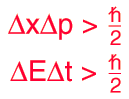
Δx Δp > h / 2
Δx is the change in a particle's position or displacement.
Δp is the change in the particle's momentum.
h is the Planck constant, 6.62606957 x 10^-34 J s
All this formula says is that the product of the change in displacement and the change in momentum is greater than a certain constant value, which implies if you try to measure either the displacement or the momentum, you can only do so within a certain error.
The Copenhagen Interpretation is a philosophical, not physics, school of thought that says because the value of the property can only be estimated to within a range (the maximum error), the property actually assumes all values within that range.
The Schrödinger's Cat thought experiment refutes the Copenhagen Interpretation by showing how ridiculous it is when applied to the real world. It takes a binary property, whether or not a radioactive particle has decayed, and converts it into a macroscopic property, whether a cat is dead or alive. If the quantum property actually can take on both states at once, so two must the cat, but that's impossible and ridiculous and no one would believe it.
Advocates of the Copenhagen Interpretation tried to bullshit their way out of this by saying that as soon as the radioactive decay is observed by the sensor, the quantum property "collapses" to one specific value. But if that actually did happen in the physical world, the Copenhagen Interpretation would be meaningless anyway as it could never have any affect on anything.
Dan8267
@
2013 Aug 30, 5:39am
Wasn't it just a "thought experiment" and not a real experiment?
Only because it would be unethical to run the experiment in real life. Newton's two bricks falling at the same time was a thought experiment as well. Thought experiments serve to show flows in logic and reasoning.
Comments 1 - 3 of 31 Next » Last » Search these comments
Using Schrödinger's cat reveals that things can be in 2 states at the same time (and I reckon are influenced by the observer if the box is opened.) I understand how this illustrates how particles can exist in two states. But I'm not sure I understand the PRACTICAL implications of the experiment.
Is it kind of like x/∞, where any number divided by infinity is 0? In other words, does the cat example help theoretical physicists to help solve bigger problems, or is it an end in and of itself, to show that the particle can exists in two states? Like more of an illustration for people who don't understand quantum physics to understand it better?