patrick.net
An Antidote to Corporate Media
1,364,380 comments by 15,735 users - stereotomy online now

The adjustable airline seats that widen according to your size
2013 Nov 14, 9:57pm 621 views 2 comments
by zzyzzx follow (9)
Comments 1 - 2 of 2 Search these comments
1
 Vicente
@
2013 Nov 15, 12:02am
Vicente
@
2013 Nov 15, 12:02am
Vicente
@
2013 Nov 15, 12:02am
Would I get seated next to Kevin Smith and talk about Silent Bob's next gig?

No it'd be more like these people:
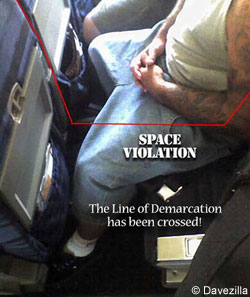

2
 Automan Empire
@
2013 Nov 15, 12:12am
Automan Empire
@
2013 Nov 15, 12:12am
Automan Empire
@
2013 Nov 15, 12:12am
Like the control that makes your dash bulbs dimmer. Dammit, I want them brighter! (Only makes sense on dark country roads, living in Los Angeles, I never realized this in the first 20 years/250,000 miles of driving)
Airline seats REALLY need a control that makes them ALL wider. Even your own girlfriend is insufferable, crammed next to you (and acting like a total bitch) from Schiphol to LAX.
Comments 1 - 2 of 2 Search these comments
http://www.dailymail.co.uk/sciencetech/article-2507441/The-adjustable-airline-seats-widen-according-size-youre-willing-pay.html
The adjustable airline seats that widen according to your size (and how much you're willing to pay)
Air travel in economy class can be rather unpleasant and much manoeuvring in an uncomfortable seat with little legroom is often called for.
But a British design company believes it has come up with a seating concept that will make even the longest of journeys more enjoyable - although it may come at a cost, depending on your size.
It is called Morph and has been designed to offer passengers choice over the amount of space they pay for and to provide a better fit for more people.
Design practice Seymourpowell said the seating solution is a ‘standard product' designed to meet the needs of a variety of people, while taking up little more room than a normal economy class seat.
The width of the seat can be adjusted, while an individual can also control the seat pan height and depth, to make sure they are comfortable.
The company said airlines could offer different widths of seat for different prices, allowing them to arrange the economy cabin by people's willingness and ability to pay for space, blurring the boundaries between the classes.
This means small travelers or children could pay less for a seat or could sell their inches to larger passengers who want more space, or business travelers who are prepared to pay more so they have more room to work.
The company believes that the seat could adapt to different people's sizes so that comfort levels could increase without a reduction in overall capacity.
Morph works by replacing the traditional foam pads used in airline seats with a fabric that is stretched across the width of three seats, around a frame and over formers, a little like a hi-tech hammock.
One piece of fabric is used for the seat back and one is used for the seat base. The fabric is clamped down by the armrests and the upper dividers, to form three individual hammock seats.
The seats can be reclined and adjusted to suit an individual's preferred seated position by moving the seat ‘formers', which in turn morphs the fabric to provide a ‘tailored fit and greater comfort,' according to the firm.
As just one sheet of fabric is used across three seats, the dividers can be moved laterally and then clamped down in a different position to adjust the width of each individual seat.
Families traveling together could book their seats according to the size of their group, so that a mother and father with a small child could pre-book a large, medium and small space.
Seymourpowell said a properly fitted airline seat is not only more comfortable, but safer too, as it reduces health risks.
The design of Morph should solve a bug-bear of many people: that their leg room is decreased if a person sitting in front of them reclines their seat.
As the recline happens within the soft furnishing, the back of the seat does not move and impinge upon another passenger's leg room.
Jeremy White, head of transport at Seymourpowell, said: ‘Passengers who can afford premium, business or first class have a choice and hence some control over their own experience.
‘For those who travel economy, there is a very limited choice of alternatives. Morph is a solution – a standard product that meets the needs of lots of different kinds of people.'
He said that Morph takes people's emotional needs into account too – such as whether they need privacy.
‘Needs change depending on the time of day, the length of the flight and the reason behind the journey. On the way out, the passenger may need to work, whilst on the way home they may want to relax or sleep. Yet we are all shoehorned into the exact same format, one that has remained unchanged for years,' he said.
The ability to move and adjust the width of seats could allow airlines to change a row of three into two premium seats to meet demand.
This would be popular with airlines that want to create a scalable offering and with passengers, who could no longer buy a seat, but a space.