patrick.net
An Antidote to Corporate Media
1,363,845 comments by 15,737 users - goofus, HANrongli, TheAntiPanicanLearingCenter, TheDonald online now

Banned Ted Talk: Tax breaks for the rich increases unemployment
2013 Jul 27, 2:48pm 7,013 views 40 comments
« First « Previous Comments 18 - 40 of 40 Search these comments
 freak80
@
2013 Jul 30, 1:13am
freak80
@
2013 Jul 30, 1:13am
Is this a joke? The top bracket cut off line is about $400k. The ones rich
enough to buy regulators are making an order of magnitude more than that! and
paying effective tax rates much lower than the top bracket.
Ok, so we *do not* really have progressive tax rates.
We should.
freak80
@
2013 Jul 30, 1:51am
We should have progressive tax rates on dividend income and capital gains so
the truly super rich who will never suffer in any absolute sense will pay more
while those in the this mid range can begin to accumulate capital and use it to
start businesses and create jobs.
Agree.
Is this a joke? The top bracket cut off line is about $400k. The ones rich
enough to buy regulators are making an order of magnitude more than that! and
paying effective tax rates much lower than the top bracket.
Ok, so we *do not* really have progressive tax rates.
We should.
Tax laws are man-made laws. Lawmakers are susceptible to capture. That's why "progressive tax" almost always penalize the the 2nd-tier 3rd-tier 4th-tier capital owners who are the very people who would otherwise offer alternatives that the masses under a monopolized system do not have. It is a system designed to win votes for the sloganeering orchestrated by the super-rich and raise more taxes so those in control of the government can spend it and entrench their monopoly even further.
freak80
@
2013 Jul 30, 1:54am
Tax laws are man-made laws. Lawmakers are susceptible to capture. That's why
"progressive tax" almost always penalize the the 2nd-tier 3rd-tier 4th-tier
capital owners who are the very people who would otherwise offer alternatives
that the masses under a monopolized system do not have. It is a system designed
to win votes for the sloganeering orchestrated by the super-rich and raise more
taxes so those in control of the government can spend it and entrench their
monopoly even further.
Ok, so how do we fix this problem?
I'm not trying to "win an argument" here. I really do want problems to be solved.
We should have progressive tax rates on dividend income and capital gains so the truly super rich who will never suffer in any absolute sense will pay more while those in the this mid range can begin to accumulate capital and use it to start businesses and create jobs.
You are assuming that the dividends will always pay out and the stock that back them never loses value. In a dynamic free market you cannot just sit back and watch your investments grow, in fact in 2008 the picture would have changed dramatically but the Fed and the government did not let that happen. A low flat tax on income and capital gains makes most sense. You can exclude lower incomes up to a certain point from both taxes. If the tax percentage is low enough and not progressive there will be enough incentive to work hard and prosper and the middle class & small business wouldn't get crushed. Also capital gains tax is problematic in the sense that it is double taxation as a stock price/dividend usually reflects a forward/future expected income stream which is then taxed again (corp. taxes) when it actually happens after you have been taxed selling your stock for a gain or getting a dividend.
Ok, so how do we fix this problem?
I'm not trying to "win an argument" here. I really do want problems to be solved.
As a start:
- Do not interfere with the markets (bailouts, money printing & first-in-line access)
- Remove any special interest regulations from the tax code
- Prosecute fraud
Do not interfere with the markets (bailouts, money printing & first-in-line access)
I'm perfectly happy to let the markets punish its participants. We'd have much sharper crashes and much sharper recoveries.....in theory. I'm unsure if cumulatively over decades it would reverse wealth disparity. I suspect it will never be tested.
Yeah. Regarding the progressive tax system and the way inflation is fudged here, after getting promoted I found myself first earning net very close to the same amount and when the reversal of the SS tax cuts and the brutal health-care inflation (rates increased by > 20%, of course not counted by the CPI) kicked in this year I started netting significantly less ;)
Ok, so how do we fix this problem?
I'm not trying to "win an argument" here. I really do want problems to be solved.
What is the problem? That some people control more resources than others at any given time? or fixed immutable caste system? The former is just the flip side of the same coin called "upward mobility." The latter is aristocracy.
I'm perfectly happy to let the markets punish its participants. We'd have much sharper crashes and much sharper recoveries.....in theory. I'm unsure if cumulatively over decades it would reverse wealth disparity. I suspect it will never be tested.
"Reverse" is the precise word. The market place is a lot better at "trading places" (reference to the 80's movie) than the government instigated "leveling" can accomplish. Government "leveling" produces a privileged caste.
 Vicente
@
2013 Jul 30, 5:04am
Vicente
@
2013 Jul 30, 5:04am
I'm unsure if cumulatively over decades it would reverse wealth disparity
Over several boom-bust cycles the problem would only magnify.
Real wealth in this country, would use every downturn to snap up even more of the pie. Poorer classes don't have the margin for strategic buys during a downturn, someone with oceans of cash who has less, still does.
 indigenous
@
2013 Jul 30, 5:10am
indigenous
@
2013 Jul 30, 5:10am
Loose the income disparity meme it is a straw man.
There will ALWAYS be income disparity, it does not matter.
What matters is the standard of living. In this country the poor have air conditioning, enough to eat, cell phones, free "education" etc etc, where else in the world does this exist?
I'm unsure if cumulatively over decades it would reverse wealth disparity
Over several boom-bust cycles the problem would only magnify.
Real wealth in this country, would use every downturn to snap up even more of the pie. Poorer classes don't have the margin for strategic buys during a downturn, someone with oceans of cash who has less, still does.
There is nothing to snap up from the poor. And there are constantly acquisitions and mergers, often more so in boom times. The only major distortion is the Fed printing all the money and giving it to crony capitalists/politicians and their lobbying sectors.
What is the problem?
The problem you spelled out in your post. Look at the quote.
You snipped the more in-detail exploration of "the problem":
That some people control more resources than others at any given time? or fixed immutable caste system? The former is just the flip side of the same coin called "upward mobility." The latter is aristocracy.
Real wealth in this country, would use every downturn to snap up even more of the pie. Poorer classes don't have the margin for strategic buys during a downturn, someone with oceans of cash who has less, still does.
You have it exactly backwards. The wealthy are far more leveraged than the middle class and the poor. The poor can't even get credit to leverage. The middle class can leverage perhaps 2:1 on equity margin accounts, and 5:1 on real estate. It's the banksters that can leverage 50:1 even 500:1. That's why the government and central bank have to step in to use the equities of and promises from future taxpayments from the middle class and output of the poor to bail out the super-rich. That's how the super-rich stay rich in a fiat-money system: massive leverage without risk to themselves.
Real wealth in this country, would use every downturn to snap up even more of the pie. Poorer classes don't have the margin for strategic buys during a downturn, someone with oceans of cash who has less, still does.
You have it exactly backwards. The wealthy are far more leveraged than the middle class and the poor. The poor can't even get credit to leverage. The middle class can leverage perhaps 2:1 on equity margin accounts, and 5:1 on real estate. It's the banksters that can leverage 50:1 even 500:1. That's why the government and central bank have to step in to use the equities and promises of future taxpayments from the middle class and output of the poor to bail out the super-rich. That's how the super-rich stay rich in a fiat-money system: massive leverage without risk to themselves.
Exactly. In 2008 some very big companies and individual investors would have gone belly-up, but instead of letting it sort out they gave the TBTFs unlimited backstop so that they not only survived but also were the only ones with enough money to snap up all the other failing businesses of relevant size, making them TBTFer.
freak80
@
2013 Jul 30, 6:05am
It's the banksters that can leverage 50:1 even 500:1. That's why the government
and central bank have to step in to use the equities of and promises from future
taxpayments from the middle class and output of the poor to bail out the
super-rich. That's how the super-rich stay rich in a fiat-money system: massive
leverage without risk to themselves.
Agree with you there. +1
But then again, what about massive deflation? That's usually not a good thing. Or at least that's what we're told.
Vicente
@
2013 Jul 30, 6:25am
The middle class can leverage perhaps 2:1 on equity margin accounts, and 5:1 on real estate. It's the banksters that can leverage 50:1 even 500:1.
Oh really?
Then how did this happen?
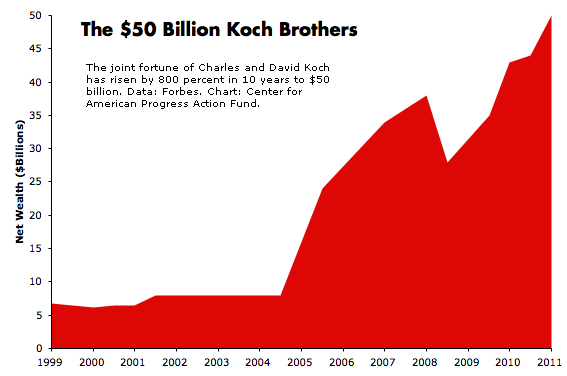
From here:http://sourcewatch.org/index.php/Koch_Brothers
Quite a few non-FIRE Richie Rich types, only got richer during the downturn.
Agree with you there. +1
But then again, what about massive deflation? That's usually not a good thing. Or at least that's what we're told.
Short deflation is not a bad thing: that's how bad debts are written off, and how new businesses can be put together cheaply by buying assets from liquidating old businesses.
Central bank intervention tends to produce stagflation.
Oh really?
Then how did this happen?
Do you not see the massive drop during the market tanking?
The massive growth of Koch brothers' fortune is due to them hitting the jackpot with natural gas and oil in the last few years. It is the booming industry. Koch Industries being a privately held company (not publicly traded stock holding company), some of the accounting values attributed to them can also be fishy.
Do you have problem with some people getting rich producing things that people want?
That's how the super-rich stay rich in a fiat-money system: massive leverage without risk to themselves.
Dare I intuit that you suggest there is some modicum of regulation needed? Hannibal Lector doesn't care how he acquires the ingredients to his "delightful amuse bouche."
The fiat money regulation is what they use to insulate themselves from the statistical tail risk. No fiat money regulation, no bailouts, and the statistical tail risk would take care of getting rid of those reckless gamblers very quickly.
Consumer freedom of choice ensures entreprenuers with efficient processes win over cronies. The job creators however are the entreprenuers who can come up with new businesses processes that are more efficient and deliver better value than existing businesses.
Say's Law. Yes, yes, we know governement intervention encourages malinvestment and leads to recessions and depressions.
We don't have any modern real world examples of this, of course, because there are no completely free market economies. Personally I would assume lower unemployment in countries of lower government intervention, but that would be using inductive or abductive reasoning instead of deductive logic.
Control of Capital in a free market is not a barrier to entry so using government regulation to limit the power of concentrated capital is counterproductive.
Really, you don't have any examples of government causing price distortions leading to malinvestment? Have you seen what all the ridiculous subsidies to the corn farmers have resulted in with this country?
« First « Previous Comments 18 - 40 of 40 Search these comments
Business Insider Article
http://www.N1b_Q1lprAk
http://www.bBx2Y5HhplI