patrick.net
An Antidote to Corporate Media
1,362,143 comments by 15,735 users - Ceffer, HANrongli online now

Comments 1 - 40 of 54 Next » Last » Search these comments
 Strategist
2016 Mar 21, 6:03pm
Strategist
2016 Mar 21, 6:03pm
Likely or not? Discuss.
He does not even mention WHY home prices will fall.
He does not realize home building for the last 9 years has not kept up with population growth. We have a shortage. If anyone believes home prices will crash I would like to know why, given the facts I just stated.
 Heraclitusstudent
2016 Mar 21, 6:05pm
Heraclitusstudent
2016 Mar 21, 6:05pm
A crash assumes a bubble, instead there is a shortage of entry level housing units.
There may be a small drop if there is a recession, but otherwise prices just reflect scarcity.
People need a home, rents are high, they will pay what is needed to get them that.


Stock market real P/E ratio is significantly above the historical norm of 16.6
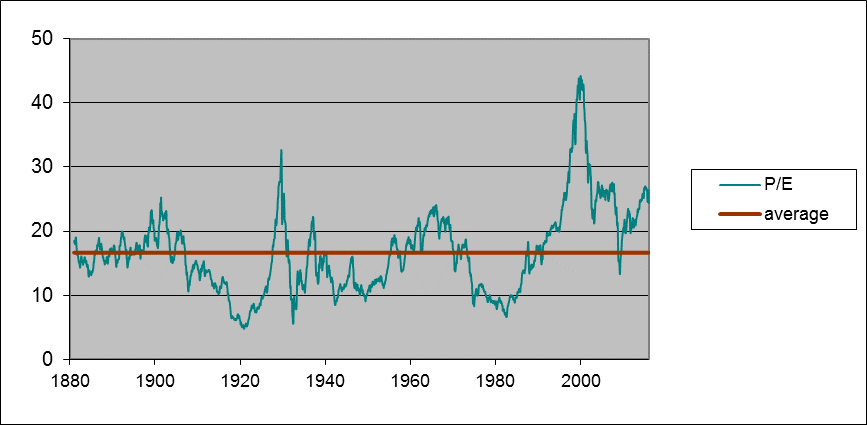
As Professor Hamilton points out: Between 1881 and 2005, if you bought stocks in a month when the P/E was 25 or higher, your average annual real capital gain from holding stocks over the next decade would only be 1.2%.
Real house prices (adjusted for inflation less shelter):
Price to rent ratio:
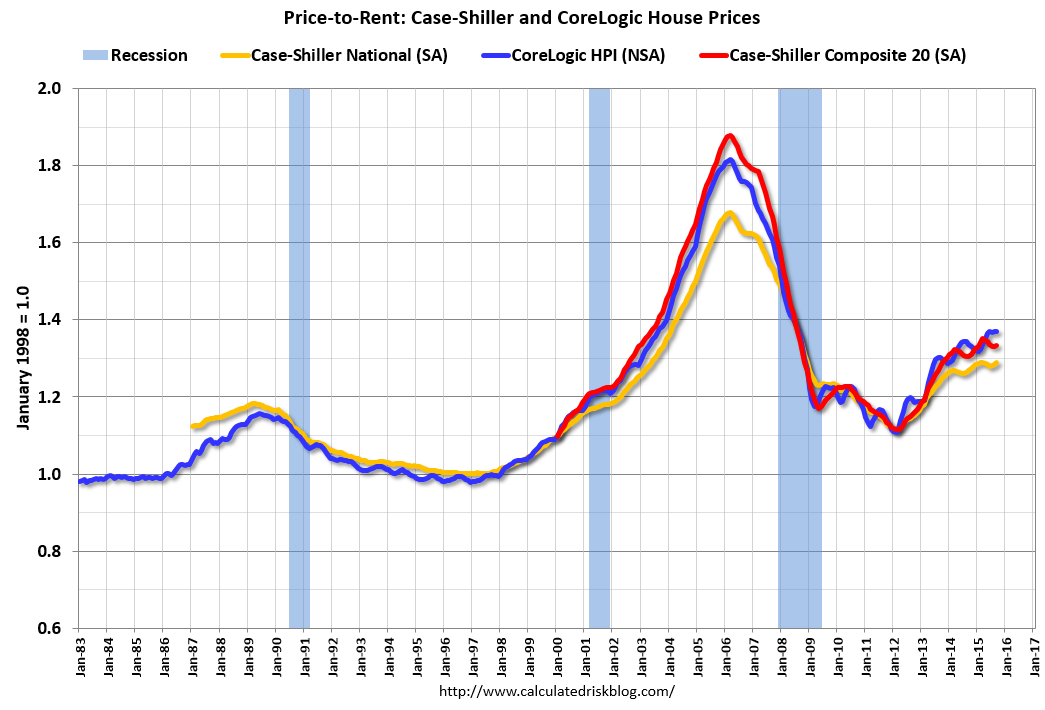
Near 2003 levels.
Unlikely for an imminent crash, although prolonged periods of stability is not necessarily a healthy sign.
Strategist
2016 Mar 21, 7:09pm
"Homes are not affordable, Homes are not affordable, Homes are not affordable, Homes are not affordable, Homes are not affordable.
If homes are not affordable, why are the home prices going up?
 Done
2016 Mar 21, 7:19pm
Done
2016 Mar 21, 7:19pm
Home buyers got greedy and missed the trade.... Thought they would out last the market and get their crash....
Not going to happen.... Big money, scared money buying them up..... Step up to the plate or get left behind.....
Your competing not only with US buyers but buyers that really have reason to be scared through out the world...
The price-to-rent ratio graph is interesting. In previous troughs, the ratio dropped to 1.0...that still hasn't happened since Housing Bubble 1.0 because of cheap money, artificial supply constriction, etc. The "powers that be" are doing everything they can to prop up prices, but are they fighting the inevitable...which is a price-to-rent ratio of 1.0??
which is a price-to-rent ratio of 1.0??
Here's the letter that explains it.
From Calculated Risk blog:
This graph shows the price to rent ratio (January 1998 = 1.0). On a price-to-rent basis, the Case-Shiller National index is back to June 2003 levels, the Composite 20 index is back to January 2003 levels, and the CoreLogic index is back to October 2003. In real terms, and as a price-to-rent ratio, prices are back to 2003 levels - and the price-to-rent ratio maybe moving a little sideways now.
Thanks, but I'm not sure how that answers the question of whether we inevitably need to get back to a ratio of 1.0 just from a market health perspective. If the ratio is higher than 1.0, it would seem that housing is over-priced (in comparison to rents); this makes sense in times of economic boom because everyone wants to own, invest, etc in housing because there's money chasing the asset class.
this makes sense in times of economic boom because everyone wants to own, invest, etc in housing because there's money chasing the asset class.
When wealth effect is the point of quantitative easing, which money is NOT chasing an asset class?
Strategist
2016 Mar 21, 7:45pm
Thanks, but I'm not sure how that answers the question of whether we inevitably need to get back to a ratio of 1.0 just from a market health perspective. If the ratio is higher than 1.0, it would seem that housing is over-priced (in comparison to rents); this makes sense in times of economic boom because everyone wants to own, invest, etc in housing because there's money chasing the asset class.
It's the other way round. If housing is cheap the ratio is above 1. The "1" seems to be an arbitrary base to begin with.
It's the other way round. If housing is cheap the ratio is above 1.
Are you sure about that? A high price-to-rent ratio means that higher housing prices exist to a lower rental return. If housing is cheap, that means the ratio is lower
The "1" seems to be an arbitrary base to begin with.
Right, but it's a frame of reference at least. Otherwise, what do you have to gauge whether housing is over-priced or not?
Strategist
2016 Mar 21, 7:52pm
It's the other way round. If housing is cheap the ratio is above 1.
Are you sure about that? A high price-to-rent ratio means that higher housing prices exist to a lower rental return. If housing is cheap, that means the ratio is lower
Sorry you are right. It's my Johnny Walker talking.
Strategist
2016 Mar 21, 7:56pm
The "1" seems to be an arbitrary base to begin with.
Right, but it's a frame of reference at least. Otherwise, what do you have to gauge whether housing is over-priced or not?
We could call that frame of reference "0.1" Now homes are under priced.
We could call that frame of reference "0.1" Now homes are under priced.
Uuuuhhhhh...you drinking JW Black or Blue? That graph would indicate housing is "over" priced.
Strategist
2016 Mar 21, 8:08pm
We could call that frame of reference "0.1" Now homes are under priced.
Uuuuhhhhh...you drinking JW Black or Blue? That graph would indicate housing is "over" priced.
JW Black. The Blue costs too much.
The graph is too arbitrary. It loses any meaning.
Done
2016 Mar 21, 10:02pm
When wealth effect is the point of quantitative easing, which money is NOT chasing an asset class?
Not only asset class, there's all kinds of different players and like I mentioned in another post somewhere I believe RE
will be an easy ride, nice and steady up trend. Building on that thought the USD is just stepping down in my opinion. It has the #'s
to be able to afford a deep retest before buyers are likely to commit and all the while SPX500 moves up. There putting cash where
Bears will be going against the trend to put it simply by the #s, you know what that means right "S/S". Realize also bonds are still
being bought and they say the same thing. Not all markets are the same some like to snap.... lol SPX500 is likely to get more volatile
From my frame of reference it has already confirmed it's heading higher and we are likely to feel it in vol. Retesting will be bear trapping,
that is the sound you will be hearing.... lol Keep an eye for price to breach and stay above 2053 for any length of time .30-.45mins., that will
be another strong conformation and more massive support with relatively 40-50 pts.2080-90 to be had. Kind of like housing up....
VIX confirmed it should go down and a pip below today's low is a 2nd confirmation and 13-12.75 is likely which is not a lot but enough,
it also closed below 14.5 1st confirmation 14.5 thru 16.5 are tense. 20pts in SPX500 would be reasonable and satisfactory.
Done
2016 Mar 21, 10:08pm
VIX confirmed it should go down and a pip below today's low is a 2nd confirmation and 13-12.75 is likely which is not a lot but enough,
it also closed below 14.5 1st confirmation 14.5 thru 16.5 are tense. 20pts in SPX500 would be reasonable and satisfactory.
Vix also closed tight on Friday and this week will be short so I expect traders are likely to execute some trades.
 Waitup
2016 Mar 22, 5:30am
Waitup
2016 Mar 22, 5:30am
Likely or not? Discuss.
The next housing crisis is here
And it is not a crash
http://www.businessinsider.com/housing-supply-crisis-is-looming-2016-3
Done
2016 Mar 22, 7:10am
The next housing crisis is here
And it is not a crash
Pandemonium in the streets.....
 tatupu70
2016 Mar 22, 9:53am
tatupu70
2016 Mar 22, 9:53am
Thanks, but I'm not sure how that answers the question of whether we inevitably need to get back to a ratio of 1.0 just from a market health perspective. If the ratio is higher than 1.0, it would seem that housing is over-priced (in comparison to rents); this makes sense in times of economic boom because everyone wants to own, invest, etc in housing because there's money chasing the asset class.
No, you're reading the graph incorrectly. 1 doesn't mean renting and buying are at par, it just means that the rent/price ratio is the same as it was in January 1988.

No, you're reading the graph incorrectly. 1 doesn't mean renting and buying are at par, it just means that the rent/price ratio is the same as it was in January 1988.
I understand that. My point is that no one knows what "par" is, so all anyone has to go off of is what history tells us. If you're saying that the baseline ratio continues to increase over time, then real estate investing is becoming less and less profitable. That doesn't seem sustainable. Don't focus so much on the "technicals" of the graph as opposed to what the trends mean.
tatupu70
2016 Mar 22, 1:34pm
No, you're reading the graph incorrectly. 1 doesn't mean renting and buying are at par, it just means that the rent/price ratio is the same as it was in January 1988.
I understand that. My point is that no one knows what "par" is, so all anyone has to go off of is what history tells us. If you're saying that the baseline ratio continues to increase over time, then real estate investing is becoming less and less profitable. That doesn't seem sustainable.
Nope--could be that 1988 was a time when owning was much cheaper than renting. Could be you need to adjust for interest rates. My point was that you can't assume 1 is the right baseline.
There are lots of calculators out there that will tell you if a house if overpriced using rents as a guide. When I've run the numbers, the prices don't seem out of whack.
 deepcgi
2016 Mar 22, 1:34pm
deepcgi
2016 Mar 22, 1:34pm
It's an over leveraged asset class with huge speculative cash movement. The demand is an illusion, just as it was before. Affordability also makes the high end perilous, because wage inflation pressure is ignored for as long as possible. Top that with the fact that these "safe investments" are simply shacks on tiny bits of land in a world where it is decreasingly important for proximity to affect trade, and you have a massive leverage problem at the banks.

Nope--could be that 1988 was a time when owning was much cheaper than renting. Could be you need to adjust for interest rates. My point was that you can't assume 1 is the right baseline.
So you're admitting that real estate (as rentals) is becoming less attractive (when compared to history) as a means of investment.
Done
2016 Mar 22, 1:54pm
There are lots of calculators out there that will tell you if a house if overpriced using rents as a guide. When I've run the numbers, the prices don't seem out of whack.
I agree and their lucky the dollar is carrying strength so in essence that equals cheaper housing over all...
tatupu70
2016 Mar 22, 1:57pm
So you're admitting that real estate (as rentals) is becoming less attractive (when compared to history) as a means of investment.
Maybe. I'd have to see the details behind their calculation to say for sure. I don't think you can ignore the effect of low interest rates on the equation.
I don't think you can ignore the effect of low interest rates on the equation.
So are you saying that higher interest rates would negatively impact the price component of the equation?
tatupu70
2016 Mar 22, 2:02pm
So are you saying that higher interest rates would negatively impact the price component of the equation?
I'm saying that low interest rates make the cost of money cheaper. And they reduce the opportunity cost of down payment/purchase price.
But I see where you're going to go with this. Historically, nominal prices rise in conjunction with interest rates because rising rates usually indicate a strong economy and strong wage gains. So let's not rehash this again.
But I see where you're going to go with this. Historically, nominal prices rise in conjunction with interest rates because rising rates usually indicate a strong economy and strong wage gains. So let's not rehash this again.
Have you and I talked about this before? I don't believe we have.
Anyway, I'm confused because you first say interest rates matter to house prices but then you say they're only a symptom of what is going on and not a contributing factor. Which is it? Do interest rates only affect house prices when rates are low but not when they're high?
tatupu70
2016 Mar 22, 2:26pm
Anyway, I'm confused because you first say interest rates matter to house prices but then you say they're only a symptom of what is going on and not a contributing factor. Which is it? Do interest rates only affect house prices when rates are low but not when they're high?
Didn't mean to imply you and I specifically had talked about it, just that it had been discussed frequently in the past.
What I said was interest rates matter (quite a bit) to the rent/buy decision which is a much different statement than what you attribute to me. Given price x and rent y--the decision whether to buy or rent is dependent on interest rates. Now, interest rates certainly have an effect on house prices, but that effect is typically drowned out by other effects that have an opposite effect (wage gains).
Does that help?
 justme
2016 Mar 22, 3:07pm
justme
2016 Mar 22, 3:07pm
Anyway, I'm confused because you first say interest rates matter to house prices but then you say they're only a symptom of what is going on and not a contributing factor. Which is it? Do interest rates only affect house prices when rates are low but not when they're high?
Donny, I realize your question probably was rhetorical, but here goes anyway. I'm going to give a VERY sarcastic answer: When interest rates are low, housing prices go up because payments are cheap due to the low interest rates, even if "the economy" is bad. When interest rates are high, that must be because "the economy" is good, and therefore housing prices go up, then, too. Conclusion: Housing prices always go up, no matter what!!
The above is how some people think about it, but of course it is wrong. As we all know by now (2008), housing prices do NOT always go up. People who adhere to the above view completely ignore a whole bunch of factors, the biggest of which is the rampant forcing down of interest rates that is being performed to inflate housing prices at ANY cost. We have now been at zero interest (essentially zero) on bank deposits for the last 8 years. A new bubble has inflated, and it will burst, too, unless a serious round of wage inflation can be ignited. But as we all know, the Fed hates wage inflation (because it makes the rich poorer). The Fed only loves asset inflation (because it makes the rich richer).
The above is how some people think about it, but of course it is wrong. As we all know by now (2008), housing prices do NOT always go up. People who adhere to the above view completely ignore a whole bunch of factors, the biggest of which is the rampant forcing down of interest rates that is being performed to inflate housing prices at ANY cost. We have now been at zero interest (essentially zero) on bank deposits for the last 8 years. A new bubble has inflated, and it will burst, too, unless a serious round of wage inflation can be ignited. But as we all know, the Fed hates wage inflation (because it makes the rich poorer). The Fed only loves asset inflation (because it makes the rich richer).
This is very helpful, thank you. So do you believe the price-to-rent ratio today is still too high base based on the graph that was presented earlier? It would seem that low interest rates would cause it to rise and that there's a correlation there. If that's true, then I would imagine someone should NOT invest in the housing market (I'm generalizing...I know markets are local) because it's over-priced and needs to drop down to gain proper equilibrium at some point.
What I said was interest rates matter (quite a bit) to the rent/buy decision which is a much different statement than what you attribute to me. Given price x and rent y--the decision whether to buy or rent is dependent on interest rates. Now, interest rates certainly have an effect on house prices, but that effect is typically drowned out by other effects that have an opposite effect (wage gains).
Does that help?
It does. You mentioned that higher interest rates mean the economy is doing well. Does that mean really low interest rates (like what we have today) signify a poor economy?
tatupu70
2016 Mar 22, 3:24pm
It does. You mentioned that higher interest rates mean the economy is doing well. Does that mean really low interest rates (like what we have today) signify a poor economy?
I think you're playing games now, but I'll bite
Yep--in general.
Comments 1 - 40 of 54 Next » Last » Search these comments
www.tfKWQ0SyVlo
Likely or not? Discuss.